Class Outings Planned Around Spain's School Rules
A school trip in Spain follows its own decree, Real Decreto 443/2001. It decides who travels with the children, how they sit and which papers the school should see.
When the decree applies
It covers a hired coach or minibus when at least three quarters of the passengers are under 16. On those trips an adult other than the driver looks after the children and sits near the middle or rear door. If half the children or more are younger than 12, that grown-up is needed on any bus trip the decree covers.
No child shares a seat. Smaller pupils, from three years old up to 135 cm, ride in an approved child seat when the vehicle has one, or else wear the belt. The vehicle carries the V-10 sign at front and rear, and its speed limit is 10 km/h below that of other buses on the same road.
Papers the school should ask for
Before the day, the school, as the party hiring the bus, should see three things from the operator: proof of its authorisation for discretionary transport, an ITV card that is still valid, and unlimited liability cover for everyone on board. The vehicle may be at most 16 years old from first registration on 1 September of the school year.
Rules worth knowing first
- On those trips at least one suitable adult other than the driver must be on board to look after the children, seated near the central or rear service door (art. 8.1); an adult is also required on any bus transport covered by the decree when at least half the passengers are under 12
- Children board and leave by the door nearest the driver or the accompanying adult; near a school this is supervised by an adult (art. 10.4)
- Seat belts must be worn wherever fitted; children aged three or over who are 135 cm tall or shorter use an approved child restraint where one is available, otherwise the seat belt (RGC art. 117)
Day trips that work for a class
Toledo, about 74 km from Madrid, is a favourite. Coaches set down only at Safont, the Paseo de Recaredo or the Puente de San Martín. The city charges tourist coaches for those stops, but school trips under the decree are exempt once the exemption is requested with the plate and the date.
Segovia's coaches let pupils off on the Avenida de la Vía Roma, close to the aqueduct. At the Alhambra a group is at most 30 people, teachers included, and the Nasrid Palaces time on each ticket must be kept. At the Mezquita in Córdoba, guided groups of more than ten use radio guides.
What travellers ask us
Does a minibus count as a school vehicle?
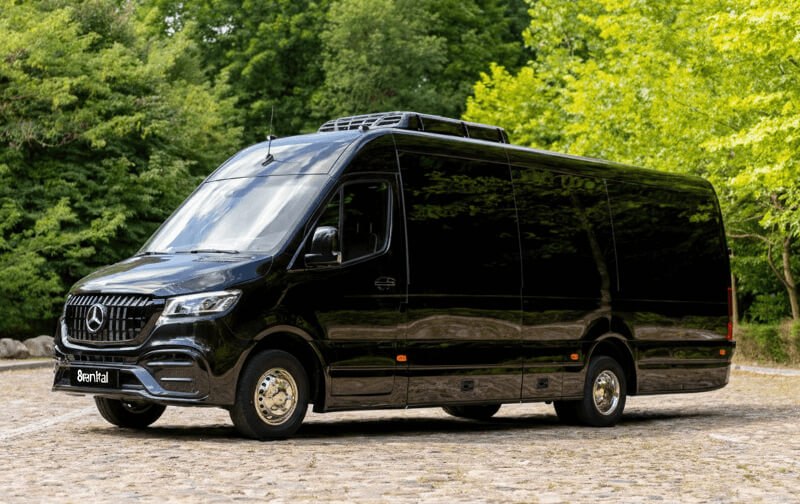
With more than nine seats including the driver it is a bus, so the decree applies just as it does to a coach once three quarters of the children are under 16.
Can a parent be the escort?
The decree asks for a suitable adult other than the driver. A parent can take that role if the school agrees.
How far can a class go and come back in a day?
Nine hours of driving a day is the cap, with a pause of 45 minutes due after four and a half. Salamanca from Madrid is about 213 km, roughly three hours each way, so it makes a long day; Segovia, about 95 km, is far easier.
Other places for your group
Other vehicles with a driver
- Full-size coach (autocar) — Seats: 49-57
- Midi-coach (midibús) — Seats: 29-35
- Minibus (minibús) — Seats: 9-16 passengers plus the driver
- Executive Sprinter-style minibus (minibús ejecutivo) — Seats: 8-16 passengers plus the driver
- Executive car with driver (VTC, vehículo de turismo con conductor) — Seats: 1-3 (up to 8 passengers in a van-type car)
- Wheelchair-accessible minibus (minibús adaptado) — Seats: Varies by layout; wheelchair positions replace seats