A Full-Size Coach for When Everyone Comes
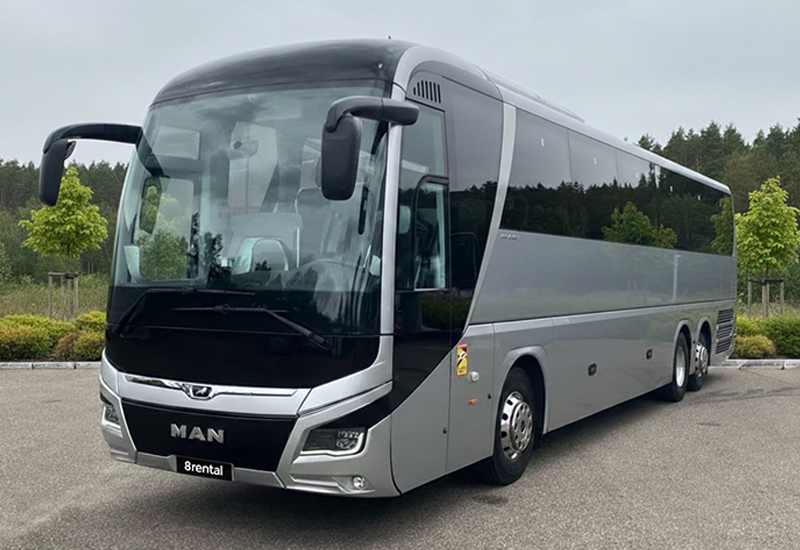
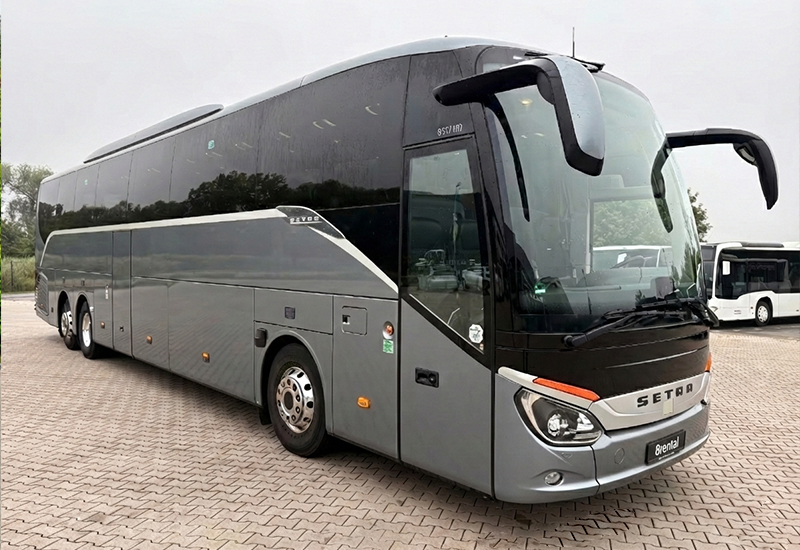
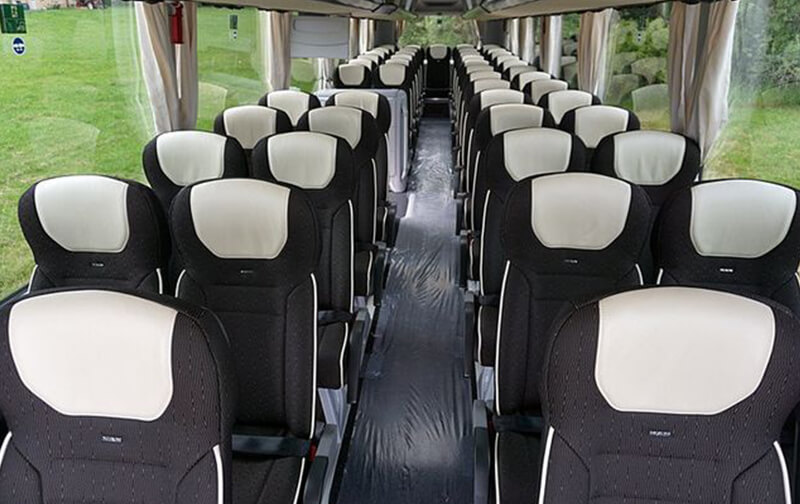
Most trips we arrange start with a minibus, but some groups simply outgrow one. A full-size coach seats 49 to 57, carries a week of luggage in its underfloor holds, and keeps a big party on one timetable.
When a coach is the better choice
Think of a wedding with eighty guests, a whole school year, a club tour with supporters, or a multi-day circuit where everyone has a suitcase. Two minibuses give more freedom, but one coach means a single meeting point and a single departure time.
On board
- For low-emission zones, a diesel coach meeting Euro VI is classed C (green label) and one meeting Euro IV or V is classed B (yellow label) (Reglamento General de Vehículos, annex II.E)
- A tachograph records driving, breaks and rest, and the EU drivers' hours rules apply
- Drivers of passenger vehicles with more than nine seats may not exceed 0.3 g/l of alcohol in the blood (0.15 mg/l in exhaled air) (RGC art. 20)
- Seat belts must be worn wherever they are fitted; in vehicles with more than nine seats, passengers are told so by the driver, the guide or the group leader, by audiovisual means or by signs at each seat (RGC art. 117)
- Outside built-up areas, buses may drive at up to 100 km/h on motorways (autopistas and autovías) and 90 km/h on other roads; the limit is 80 km/h on any road outside built-up areas if passengers are standing or the bus has no seat belts (RGC art. 48.1)
- The driver holds a category D licence, for vehicles built to carry more than eight passengers besides the driver (Reglamento General de Conductores, art. 4); professional drivers also hold the professional qualification (CAP), shown by the EU code 95 on the licence or on a driver qualification card (Real Decreto 284/2021)
- A bus or coach (autobús o autocar) is a motor vehicle with more than 9 seats including the driver (Reglamento General de Vehículos, annex II)
- Carrying passengers for payment by road in Spain needs a public transport authorisation (LOTT art. 42); group coach hire is discretionary transport (transporte discrecional), contracted as a rule for the whole vehicle (LOTT art. 99.3)
What Spanish rules require
A coach counts as a bus under Spanish law, as does any vehicle with over nine seats. Behind the wheel is someone with a category D licence and the professional CAP qualification: look for code 95 on the licence, or a qualification card. A group hire covers the whole vehicle under the operator's public transport authorisation, and a tachograph logs the driving and rest.
Out of town a coach tops out at 100 km/h on the motorway and 90 km/h on ordinary roads. If seats have belts, everyone wears them; expect a reminder from the driver or group leader, or a sign on the seat back. And the driver works to a tighter alcohol limit than a private motorist.
Where a coach cannot stop
Old towns are the catch. In Toledo, coaches use only the three set places, the Dársenas de Safont, Recaredo and the San Martín bridge, and never Zocodover. In Segovia they set down on the Avenida de la Vía Roma. In Barcelona, every stop in a Zona Bus special area, such as the Sagrada Família, is booked ahead and lasts up to ten minutes. Beside Córdoba's Mezquita, microbuses are the only group vehicles allowed.
For low-emission zones, a coach meeting Euro VI is classed C, with the green label, while Euro IV and V coaches get the yellow B. Each city sets its own entry rule, and the operator checks it for your route.
What travellers ask us
How many people fit?
Usually 49 to 57 seated passengers. The exact figure depends on the vehicle, and the quote names it.
Can a coach drive up to the Alhambra?
Yes. Coaches use the Alhambra's own coach area, P-4, reached from the ring road and the Ronda Sur.
Can we take a coach around Mallorca?
Yes. Coaches and drivers for transfers and tours there are based on the island, so the hire starts in Palma.
More trips we can arrange
- Team Days Out, with Someone Else at the Wheel
- Class Outings Planned Around Spain's School Rules
- Getting the Squad to the Match Together
- Wedding Transport for the Guests and the Couple
- Wine Country While Someone Else Drives
- Day Trips from the City at Your Own Pace
- From the Ship to the Hotel, Airport or Hills
- Travelling Together When Someone Uses a Wheelchair